
September 17, 2026
Q&A with InfraTech® Fund Partner Grant Allen on Muon Space Investment

In August 2026, I Squared Capital’s growth-stage technology platform, InfraTech®, invested in Muon Space as part of the company’s $250 million Series C financing.
We sat down with Grant Allen to discuss InfraTech®’s investment thesis and why satellite infrastructure is becoming increasingly relevant to the physical economy.
Q: You’ve just invested in Muon Space. Tell us about it.
Muon is a vertically integrated space company. It’s what we call “full stack”:
they design, build, and operate complete satellite constellations. Think of it like the AWS or Azure for sending things into space. Web companies need a website but don’t actually want to own or manage complex server infrastructure. Launch providers like SpaceX and Stoke Space handle the ride up; Muon handles everything else.
Q: So what sort of things is Muon sending to space?
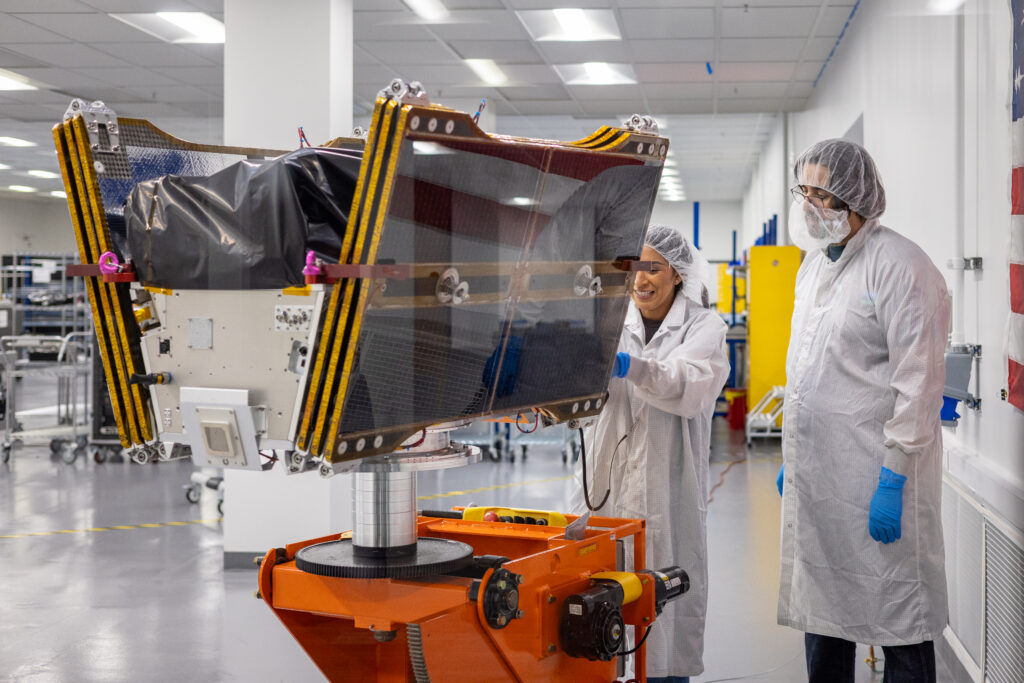
So, as of today, Muon has 11 satellites on orbit across six launches, all of which have a 100 percent mission success rate. Currently, Muon has more than 50 satellites in development for customers including NASA, NOAA, the U.S. Space Force, Google, Sierra Nevada Corporation, and Hubble Network, and a new San Jose facility designed to produce up to 500 satellites a year by 2027.
One of the best use cases to date for Muon has been FireSat. FireSat is the first satellite constellation purpose-built to detect wildfires. Muon developed it with Earth Fire Alliance, with support from Google.org and Google Research. Its multispectral infrared sensors can detect a fire roughly five meters by five meters, about the size of a classroom, and can see it through smoke and cloud. The first operational satellites entered service earlier this year and the system already revisits fire-prone regions at least twice a day. The full FireSat constellation is designed to deliver hourly coverage by 2029.
As you can imagine, FireSat has a lot of benefits in our view. Chief among them is early detection. This not only protects communities who are in danger but can save the grid, utilities, and transport corridors that wildfire impacts. FireSat also proves the Muon model. Google and Earth Fire Alliance did not need to become satellite operators, but they worked with Muon to define the outcome they wanted, and Muon delivered the mission end to end. TIME named FireSat one of the Best Inventions of 2025.
Q: Why did I Squared invest?
Beyond it being a literal rocket ship of a company in terms of its growth, we believe the economics look surprisingly like infrastructure. Value in space is migrating from building and launching spacecraft to owning the mission and delivering a service. Muon’s customers sign multi-year programs; the first satellites establish the relationship, and recurring operations and data revenue compound from there. Once a mission runs on Muon’s platform, switching providers means redesigning the mission, so retention behaves the way it does in fiber or towers.
The demand backdrop is also appealing because secular shifts are changing what can be built and operated in space. Launch costs to low Earth orbit have fallen roughly 95 percent over two decades, and government procurement is shifting from large incumbent aerospace and defense contractors toward commercial operators. Together, those shifts are expanding the frontier of infrastructure: space is becoming a practical sensing and connectivity layer for critical systems on Earth, from wildfire detection and weather monitoring to logistics, utilities, and national security. Layer on top of that a repeat founding team and a heavily oversubscribed $250 million financing round, and you have an investment opportunity that meets I Squared’s philosophy of transformative infrastructure. Our diligence was old-fashioned: we called the customers, and the consistent message was that once Muon is flying your mission, you don’t leave.
Q: You run I Squared’s Infratech strategy, how does InfraTech and investments like Muon fit with I Squared’s more traditional infrastructure investments?
The premise for Infratech was always about identifying and capitalizing on advanced technologies for the physical economy. With the advent of AI, we see a fundamental reshaping of the physical world. That theme is not only speeding up but being at the core of the transformative infrastructure that I Squared has always looked to back.
Think about what makes an infrastructure asset attractive in the first place: long-term contracts, steady recurring revenue, high upfront capital costs, and services that are essential, not optional. Access to space, and in the case of Muon, satellite constellations, are starting to look exactly like that. The constellation itself is like a fiber network; the operations and data platform on top of it is the delivery layer, similar to what a telecom carrier provides.
Then there’s the data these satellites produce, and almost all of it feeds back into the physical world we already know well. Wildfire and weather data can help protect power grids, utilities, and transport corridors. Tracking data, like the Bluetooth-based tracking Hubble Network runs on Muon’s satellites, can support logistics and supply chains. We see that demand through the infrastructure sectors we already know well. Across power, utilities, transport, and logistics, operators increasingly need better real-time visibility to protect assets, route goods, manage disruption, and improve resilience. Space is not a side bet for us; it is becoming the sensing and connectivity layer that sits above the infrastructure we have invested in for years.
Q: What comes next for Muon?
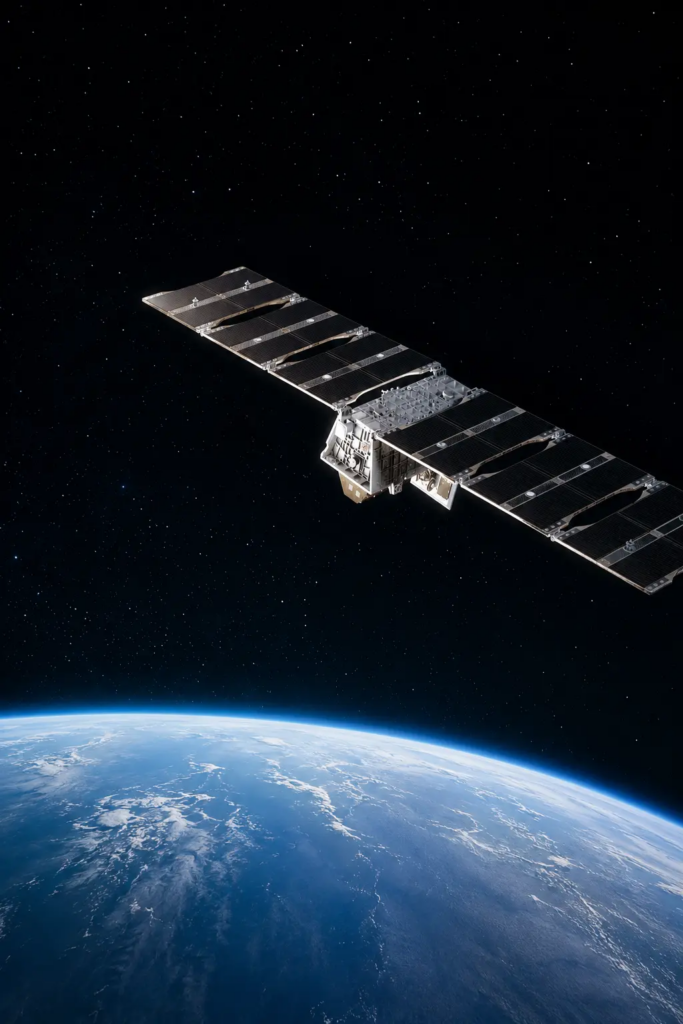
It’s really about scaling the Mission Foundry platform now. The San Jose facility that Muon recently opened is designed to increase annual production capacity to 500 satellites, and the technical roadmap includes larger spacecraft, more advanced payloads, on-orbit AI computing, and higher-bandwidth connectivity. Customer demand is also building, with more than 50 satellites in development and 13 expected to launch within the next year across commercial, civil, and national security customers.
This next phase requires relentless execution, but that’s what the team knows well. They already grew and sold a business to Google for $500M. Scaling a sophisticated hardware platform and a production center at the same time is difficult, but that is also what makes the opportunity compelling for us investing at the Series C stage. Muon has already shown it can deliver complex missions for demanding customers, and we believe the company is well positioned to build from here.
Read the Muon press release >
DISCLOSURES
This website does not constitute advice or a recommendation or offer to sell or a solicitation to deal in any security or financial product. It is provided for information purposes only and on the understanding that the recipient has sufficient knowledge and experience to be able to understand and make their own evaluation of the proposals and services described herein, any risks associated therewith and any related legal, tax, accounting or other material considerations. To the extent that the reader has any questions regarding the applicability of any specific issue discussed above to their specific portfolio or situation, prospective investors are encouraged to contact I Squared or consult with the professional advisor of their choosing. Certain information contained herein has been obtained from third party sources and such information has not been independently verified by I Squared. No representation, warranty, or undertaking, expressed or implied, is given to the accuracy or completeness of such information by I Squared or any other person. While such sources are believed to be reliable, I Squared does not assume any responsibility for the accuracy or completeness of such information. I Squared does not undertake any obligation to update the information contained herein as of any future date. Except where otherwise indicated, the information contained in this website is based on matters as they exist as of the date of preparation of such material and not as of the date of distribution or any future date. Recipients should not rely on this material in making any future investment decision. Certain information contained herein constitutes “forward-looking statements,” which can be identified by the use of forward-looking terminology such as “may,” “will,” “should,” “expect,” “anticipate,” “project,” “estimate,” “intend,” “continue,” or “believe,” or the negatives thereof or other variations thereon or comparable terminology. Due to various risks and uncertainties, actual events, results or actual performance may differ materially from those reflected or contemplated in such forward-looking statements. Nothing contained herein may be relied upon as a guarantee, promise, assurance or a representation as to the future.
This material is for informational purposes only and does not constitute an offer to sell or a solicitation of an offer to buy any security. The views expressed reflect the opinions of the author as of the date of publication and are subject to change without notice. Forward-looking statements involve known and unknown risks and uncertainties; actual outcomes may differ materially from those expressed or implied. Investing involves risk; loss of principal is possible. Specific investment advice references provided herein are for illustrative purposes only and are not necessarily representative of investments that will be made in the future. Past performance is not indicative of future results.
“InfraTech” is a registered trademark of I Squared Capital.